Blogging: A new way of wasting work time?

An article by Advertising Age last week suggested that time spent in American offices on non-work blogs this year will waste the equivalent of 551,000 years or take up the equivalent of 2.3 million jobs.

Despite acknowledging that hard data on the subject is limited, Advertising Age estimates:

1) Work time spent reading and posting to blogs this year will consume 2.2% of U.S. labor force hours

2) Work time spent at blogs unrelated to work will eat up 1.65% of labor force hours

3) U.S. workers this year will waste the equivalent of 551,000 years (based on a 24-hour day) or 2.3 million work years (based on a typical nearly 40-hour work week) reading blogs unrelated to the job


The article goes on to discuss the extent to which blogging at work should be seen as a problem, but the part I found interesting was how blog traffic clearly tails off at the weekend, i.e. could it be that office workers, finding it increasingly difficult to justify leaving their work stations, use blogs as the new way of breaking off for a chat with colleagues, or sloping off to read a newspaper, etc.? Make your own mind up by looking up What blogs cost American business - (Bradley Johnson, Advertising Age).


Majority of British workforce have "itchy feet"

More than three-quarters of UK workers know or suspect that colleagues are on the lookout for a new job, according to research from Investors in People.

The research, which surveyed more than 1,600 UK employees, also says that one-fifth (19%) of employees are unhappy in their current job, with a further 33% feeling unsure and considering their future. Apparently, when workers do leave their employers the main reasons are believed to be based on the following:

1) Better pay/benefits elsewhere (39%)

2) New challenges (33%)

3) Opportunities for career progression/promotion (28%)

4) Lack of recognition for current contribution (20%)

5) Lack of development opportunities in current role (20%)

In other words, unresolved and/or unresolvable conflict between employee and employer. See Employers urged to focus on motivation to maintain productivity (Dan Thomas, Personnel Today) for more details.

Work-related Blogs and News got a brief mention in The Times last week - see Web Watch.

Perceptions of pay

According to a report by Incomes Data Services and the Trades Union Congress, nearly half of all British employees are unhappy with their pay. However, one of the most striking points made by the report suggests, overall, women are less satisfied than men with their pay, but are more reticent than men to discuss pay with their employers. See Employees unhappy over pay levels (BBC News).

In the meantime, if you want to find out whether you are falling behind in the pay stakes then check out PayWizard - a free salary checker service, letting you compare your earnings against what other people get for doing the same job.

Keeping organizations lean, literally!

Overweight workers find it harder to get jobs than their slim counterparts, an online survey suggests. The findings indicate obese people are discriminated against when applying for jobs, are passed over for promotion, and are more likely to be made redundant – all purely on the basis of their weight. It sounds more like prejudice than discrimination to me. See Overweight job hunters 'lose out' (BBC News) and Fattism rife in business (Personnel Today) for more details.

Six new blogs to add:

CAD monkey in the cubicle jungle - healthcare architect stroke corporate whore.
Da blog - the experiences of an English English teacher working in France.
Seldom updated - manager.
Serving the underclasses - the thoughts of a part time Cashier at a well known bookmakers in the UK.
The dinner lady - what understaffing, cost cutting and the trend for 'Healthy Eating' is doing to school dinners and the kids that eat them.
The fast food life - the story of one person's employment odyssey at a fast food restaurant.

Age discrimination and British managers

An interesting report on age discrimination emerged over last few days. The report entitled - Tackling age discrimination Oct_2005 was produced by the Chartered Management Institute (CMI) and the Chartered Institute of Personnel and Development (CIPD) and looks at managers and personnel professionals (across the UK) responses to issues that relate to age discrimination and career expectations.

The main findings from the report are quite worrying and include:

Six in ten respondents (59 per cent) reported that they have been personally disadvantaged at work because of their age

Nearly a quarter of those surveyed (22 per cent) admitted that age has an impact on their own recruitment decisions

Almost half (48 per cent) of those surveyed had suffered age discrimination through job applications

39 per cent believe their chances of promotion have been hindered by age discrimination, i.e over half (63 per cent) of respondents believed that workers between the ages of 30-39 years old had the best promotion prospects, with only 2 per cent citing 50 year-olds or above

A majority, (80 per cent) reported that they are hanging on to the expectation that they will personally retire by the age of 65, despite believing that the age of retirement for the average person in ten years' time will be 66 or older


Some worrying statistics there - for both management-level workers and the organizations that employ them. However, it is strange to see that the very people who are main victims of ageism are also the main perpetrators. In other words, what forces are at work when a manager discriminates on the basis of age when he or she may have been or expect to be the victim of discrimination themselves? Could one of them be commercial forces?

A summary of these findings (and more key points) can be found here.

Preliminary research findings on work-related blogs

Anyone who has been keeping an eye on my blog since it started in April 2005 should know that I've also been researching work-related blogs as well as providing commentary on a range of work-related news. I'm please to announce that some of my preliminary findings and insights into work-related blogs have been made available from my employer's research webpage - Heriot-Watt University. The paper is entitled "Straight from the horses mouth: Exploring and evaluating blogging as an emerging medium for sharing images of work" and can be downloaded here.

As these are preliminary findings and open for discussion, I would of course appreciate feedback on what I've written. However, please note that I do not wish to have my paper cited without my permission (this does not include brief references on blogs). The following guidelines explain why this is the case.

Critiquing new forms of web-based communication technology

The centre of yesterday's Guardian "G2" supplement asked the following highly credible question: Can you trust Wikipedia? The reason why I feel that it's a highly credible question relates to the plain fact that wikis, like blogs and podcasts, etc. are nearly all unregulated mediums of information, slowly, but surely, ebbing their way to mainstream acclaim.

According to one source in the article, some of its entries are a 'horrific embarrassment'. Whilst there is no reason to believe similar forms of web-based communication technology are awash with unreliable information, I sense that the future of such technologies depends on two things. First of all, those who use said technology must be sufficiently organized and ready to take action if traditional forms of media turn against their emerging counterparts. And second, users of new forms of web-based communication technology must be ready to adhere to a code of ethics that governs all such mediums, if they do not already. For example, perhaps a statement of whatever code of ethics each blogger subscribes to should be openly displayed on the blog itself.

Incidentally, apart from one minor abberation, Wikipedia stood up to criticism, although a much wider critique may have produced a different picture.

Glass ceilings: Organizational by-product or an individual's deficiency?

If research by ISR consultants (I couldn't source their original press release or actual findings through a web search - update: you can find it here) is to be believed, then, women are still finding it difficult to break through the glass ceiling. Of most concern is the belief that women are being excluded from organizational life, i.e. marginalised from high-level decision-making. One reason for exclusion suggests many women felt they did not give their best, or that they could not speak up if they lacked confidence in decisions made by others.

The article - Female managers 'squeezed out' (BBC News) - unsurprisngly, does not go into any great depth or breadth, but what concerns me the most is the use of the term "organizational life"; as if organization have a life of their own and no-one is to blame if organizations produce something beyond the purpose they were initially designed to serve. In other words, organizational (or instutionalised) sexism, racism, ageism, etc. are often portrayed as being accidental by-products of formal organizational objectives, or heavily related to the problems that individuals need to sort out for themselves. I believe much more needs to be done to make organizations accountable for everything they create and an end to blaming organizational ills on individuals who contributed little or even nothing to their subjectivity.

An interview with a work blogger

I came across an interesting article the other day whilst browsing Opinionistas - a blog about a lawyer who works for a big New York law firm. In the article, Opinionista is interviewed by The Record: The Independent Newspaper at Havard Law School. The interview can be found here. Apparently, the main reason for beginning what has turned out to be a very popular blog is based on advice from her doctor - a way to maintain optimum mental health in a high pressure job! Opinionista has also attracted quite a range of media interest and you can see several articles that relate to her blog by referring to Opinionista's Media love entry.

To add to Opinionsta's motivations to blog about her work, I've looked through some bookmarked articles (not previously mentioned on my blog), which cover this issue in some way. For instance, see Bloggers reveal their motives (BBC News), Spilling the beans (Jim McClellan, The Guardian), Telling tales (Jim McClellan, The Guardian), Looming pitfalls of work blogs (Jo Twist, BBC News), New kids on the blog (Susan Mansfield, The Scotsman), and, Words get around (Quin Parker, E-Health Insider).

I've been looking at why people blog about their work and came to the following conclusions in the entry made in April - So, why do people blog about their work?. I've gathered a quite a lot more data on why people blog about work (and continue to do so) and expect to publish something quite soon.

New technology and making better use of "dead time"

According to a survey by T-Mobile, British workers are not only keen on being liberated from their desks, they also want to gain control of "dead time" spent commuting, i.e. free up time for their private lives. The key to being liberated from losing dead time is said to be "mobile working" - or doing work whilst travelling. However, the gadget seen to be at the heart of working while you commute is the BlackBerry - a handheld wireless device providing e-mail, telephone, text messaging and web browsing and other wireless data access. A further advantage of making use of commuter time is that it may alleviate daily stress and better manage workloads, such as readings and responding to emails that previously could only be dealt with in the office environment. For further details see the T-Mobile press release.

"I'll be there for you": Friendships and the pressures of work

It is argued in an article by Daniel Allen of The Times that workplaces where the staff become more than colleagues will increasingly have a competitive advantage over their less cohesive rivals.

The article - Friends benefit firms - goes on to consider why this is the case. The main reasons offered are that strong friendships allow employees the best defence against the changing nature of work, i.e. the need to be more 'flexible' or be capable of 'multi-tasking'. A further point suggests a workplace where friendships flourish, employees are more likely to be collaborative by sharing their knowledge and expertise.

A good and interesting article, but I'm not convinced that any organization would encourage friendships to flourish in the workplace without wanting something quite specific back in return, i.e. more effort, etc. I can't help feeling first of all that managers can't engineer friendships. The second point is that employees are likely to be very cynical of any attempts to pair them off with colleagues. And third, if there comes a point where a manager needs to drive a wedge between 'friends', i.e. make one redundant or discipline them, etc. then you are going to seriously upset a minimum of two members of staff.

Dealing with violent and abusive customers

A new report published by the British Retail Consortium (BRC) suggests violence against retail staff has significantly increased since 2003. More worringly, in less than one year verbal abuse by customers has risen by 35 per cent and physical violence against retail employees is up 50 per cent since the turn of the century.

Putting the cost to businesses aside, BRC Director General, Kevin Hawkins, is quoted as saying:

"...the most disturbing figure is the growing trend of verbal and physical violence experienced by retailers. Retail crime is not victimless; it leaves deep scars not only on business viability and retail staff, but also on the community with the significant costs of prevention often passed on to all threads of society."

The report also goes on to suggest businesses need to do more when training staff to deal with threatening behaviour. I really don't think that even the best training can have any significant effect on the ability of retail workers to ward off abuse, never mind physical violence. By suggesting an employee can always be trained to do something may result in employees taking responsibility for something they have little control over in the first place. Train to sell more stuff - yes; train to stop abusive and violent people - no! The key to defending employees from customer abuse and violence starts by making it absolutely clear that employees play no role in such behaviour. After all, are women "trained" how to "deal" with abusive and violent husbands or partners?

To view the press release by the BRC see: BRC retail crime survey: cost of crime up, violence against staff up. You have to buy the full report through the BRC website, however, a summary of the report - Retail Crime Survey 2004-2005: Key Facts - can be viewed here.

Managing humour

I came across a really interesting article on Sunday that considers the role of humour in the workplace, mainly from a managerial perspective. For instance, workplace humour can be viewed as a "stress-buster", a way of raising morale, a means to defuse conflict, a tool for building rapport between employees and between employee and customer. In other words, humour appears to be some sort of cure for all evil!

However, going further in to the article, it would appear that a degree of caution may be due if a business is ready to call in "humour consultants", or ready to let line managers indulge themselves "David Brent style". It seems that the main danger in seeing humour as a way of addressing common organizational problems is that humour is rather idiosycratic. Put simply, what one person finds very funny can all too easily irritate colleagues. However, in the worse case scenario, the outcome may be catastrophic with serious offence being taken.

It seems, therefore, what can be taken most of all from the article in question - Public Opinion: Office fun? You must be joking by Adrian Furnham of The Sunday Times is quite simple: don't try and manufacture humour for the benefit of the organization unless you are prepared to pay for things if they go wrong.

A great mixture of work-related blogs to add to my collection:

Opinionistas - continuous observation of the ridiculousness of human behavior, from a lawyer.
The insane waiter - tales from the restaurant
Server stories - stories from the battlefields of a casual restaurant in the Midwest
A day in the night of a stripper - a teacher who also works in the "adult entertainment" industry
My life as a...gas station attendant - a man and his daily and weekly struggles with 40oz-guzzling vagrants, gasoline pump drive-offs, cantankerous coworkers, and eighteen-year-old gangsta potheads who don't think I can spot their fake ID's.

The strategic degradation of working conditions: Asda Wal-Mart style

Asda has come under fire from a charity accusing the supermarket group of planning a "strategic assault" on the working conditions of its staff.

War on Want and the GMB general union fear management proposals for a major shake-up in staff operations at the Lutterworth distribution centre in Leicestershire will be rolled out nationwide. They say Asda - owned by the US retail group Wal-Mart - has drawn up a "Chip Away strategy 2005" aimed at reducing costs and increasing productivity at a time of general falling British retail sales.

According to that strategy, outlined in documents shown to The Guardian - the company would like to:

- Remove the right of staff to take industrial disputes to the arbitration service Acas

- Implement the use of "single man loading" for jobs that involve lifting, even though Asda's own risk assessment acknowledges the need for two people to undertake such tasks


- Encourage supervisors to "take the credence out of breaks" by ending rest times early thereby "leading by example"

- Remove sick pay for the first three days of absence


See Asda attacked over employees' rights (Terry Macalister, The Guardian) for more details and the official response from Asda. You can also access the original press release by War on Want here and the report - Asda Walmart: The Alternative Report, here.

New technology, work and early death

According to an article by Robert McKie in The Observer yesterday: Health experts agree - emails are fattening , health experts believe millions of hours of vital exercise are being lost every week thanks to the explosion in electronic messaging. Dr Dorian Dugmore, a health adviser to Sport England (who commissioned the report) is quoted as saying the following on the matter:

'We're losing millions of hours of exercise through the explosion of email...People email colleagues who sit next to them, never mind those who work on the other side of the office. We have to change people's lazy attitudes.'

The main conclusion is that increasing activity levels by 10 per cent could save 6,000 lives and £500 million per year, as well as leading to one million fewer obese people in England. Apparantly, many employers in the UK are growing hostile to the use of email per se, although it does not seem clear whether the antagonism is based along the lines of employee welfare or business needs alone.

Employment and sexual orientation

Stonewall - a professional lobbying group for lesbians, gay men and bisexuals - has produced a guide for employers who now have to deal with new employment legislation, which is to legally protect lesbian, gay and bisexual workers against discrimination and harassment at work. You can access the guide here. The Employment Equality (Sexual Orientation) Regulations 2003 is the result of the UK’s implementation of the 2000 EU Employment Framework Directive requiring member states of the European Union to ban sexual orientation discrimination in employment by the end of 2003.

Blogging as a recruitment technique

Whilst the headline reads "Cadbury Schweppes blogs on", it is the sub-heading that is the most telling: "Online diaries will give future potential employees an insight into the organisation" (People Management).

I'll reproduce the article in its entirety as it's first of all quite short (and sweet), but mainly because it's the first prominent evidence to suggest that the HR management-orientated media, in the UK, is taking a much wider view of work-related blogging - see, for example, HR warned over staff blogs (People Management), Illegal blogging (People Management), 'Blog' dismissal should prompt policy on usage (Personnel Today), Dismissal highlights need for ‘blog’ policy (Personnel Today), and, Don't blog your way into trouble (Personnel Today). Here goes...

Graduate recruits at Cadbury Schweppes have been told to speak their minds about their jobs.

The group has been asked to contribute to a set of regular "blogs", or online diaries, launched last month, which would give future potential employees an insight into the organisation.

"We want to encourage them to speak as freely as possible," said Anthea Marris, graduate resourcing manager at Cadbury Schweppes. "We want to let them know that it's okay to write something negative because everyone has a bad day once in a while." Marris said that HR or corporate communications would only veto information that was commercially sensitive. The blogs are intended to give future employees an idea of what working at the company is like.

"We want to help potential candidates make an informed decision about whether we are the right company for them," she said.

The organisation, which relaunched its graduate recruitment scheme in 2002, will be accepting applications for next year's batch of graduate posts in the next few months and hopes the blogs will attract more candidates to the recruitment website.

Rebecca Clake, CIPD adviser, organisation and resourcing, said companies were increasingly using their websites to attract the right people. But she warned: "If you do get any negative publicity [from the blogs], then you need to be aware of the potential risk to your reputation."


A good article on the whole, but it's clear that more needs to be done about the value of work-related blogs, for both employee and employer, whether encouraged by an employer or not.

Sex and the workplace

According to Peter Done, managing director of Peninsula, ‘sex skiving’ is a growing trend among staff. A poll of 1,269 employees suggests that 7 per cent had taken a day off to recover from an "all night romp" and 48 per cent said they'd had a sexual encounter in the workplace. However, the main question posed by Michael Miller of Personnel Today is: is sex interfering with work? Perhaps it should be the other way round!

A report by the Chartered Management Institute suggests organisations need to be more energetic and dynamic if they are to match the needs of their staff. It would seem that a key finding from the report is that there appears to be a worrying mismatch between what managers hold dear to their hearts compared to the values of their employer. See the actual report - Motivation Matters for much more detail.

Some more news emerged today about two forms of web-based communication technology. In the first example, it is reported that Yahoo, Apple and the BBC are all jumping on the podcasting bandwagon. However, the main question to be asked is: where does the broadcasting revolution go from here? It's probably best to read the article for yourself - A word in your ear by Bobbie Johnson of The Guardian, but I liked one comment made at the end of it that suggests Podasting is not so much about discovering new talent for large corporations it is more about being:

...an outlet for personal expression, much like blogging, and is not intended to compete with the professionals.
A second article takes at look at how large corporations appear to be taking an even bigger interest in new based technologies such as instant messenger. In Yahoo! and Microsoft join forces to seize instant messaging initiative by Richard Wray of The Guardian, a telling comment by MSN vice-president Blake Irving outlines how the merger of two services, "...heralds a new way for customers to create closer communities". However, a more critical eye suggests Yahoo and MSN are keen to join forces, i.e. share knowledge and new data on IM users as a means to inflitrate a range of thriving and enthusiastic on-line communities. See a previous post of mine on big business and blogging for a similar take on emerging business interests in web-based communication technologies.

Police blogger in trouble

As you can see from the visual effects, the The Mail On Sunday ran a big article on The Policeman's Blog earlier this week. It's not the first time that The Policeman's Blog has mentioned in the media - see previous posting of mine. Unlike previous exposure from the BBC, The Guardian and The Times, it would appear that the Mail On Sunday did not ask for permission to publish several blog entries, which covered a range of controversial subjects. The result, it seems, is that "David Copperfield" has suspended his extremely popular blog, at least for the time being.

I've simply not had time to scour other blogs for commentary on what may result in someone losing their job and may be so much more, but I did come across some helpful advice from Bill Sticker at Walking The Streets: A Traffic Warden's Diary. In his post - Breach of Copyright - Bill suggests bloggers should include a short statement of copyright on their blog. I'm no lawyer, but it seems that this is the least anyone could do in such a situation.

When the Internet becomes two or three...

It appears that a battle may have erupted over who governs the internet, with America demanding to maintain a key role in the network it helped create and other countries demanding more control. In an article by Richard Wray of The Guardian - EU says internet could fall apart - the European Commission is warning that if a deal cannot be reached at a meeting in Tunisia next month the internet will split apart, i.e. if a multilateral approach cannot be agreed, countries such as China, Russia, Brazil and some Arab states could start operating their own versions of the internet and the ubiquity that has made it such a success will disappear.

The main thing I took from the article is that if the Internet does crumble because it is seen to be over-dominated by one nation, even if this one nation - the USA - may well have played a major role in creating and developing the network, the alternative - i.e. competing 'Internets', would arguably divide the world in an unprecedented way and further reinforce ethnic conflicts. Let's hope the talks in Tunisia arrests the chances of an Internet apartheid.

The following articles seem trivial by comparison. In Blogs vie with news for eyeballs it is suggested that bloggers are gaining a higher profile alongside traditional news sources with Yahoo including blogs in its expanding news search system (BBC News). Secondly, in Bang blast, is the story of how British blogs have recently found themselves getting comments from a fictional character who promotes a household cleaner - a new, personalised form of advertising(BBC News).

The reality and rhetoric of recruitment and selection

Virgin Blue discriminated against older hostesses 'for young blondes' - an airline owned by Sir Richard Branson was found guilty yesterday of discriminating against older women who applied to become air hostesses. Eight women aged between 36 and 56 took their case against the budget carrier Virgin Blue to a tribunal, after being put through job interviews that required them to sing and dance. One woman was told she lacked "Virgin flair" (Michael Blackley, The Scotsman). By the sounds of it, advice given in the following article - what not to say in an application - is unlikely to have resulted in a different outcome (BBC News).

It seems that the UK government is keen to extend paternity leave from 2 weeks to six months. The Parental Rights Bill includes the following key measures:

Power to extend the period of Statutory Maternity Pay, Maternity Allowance and Statutory Adoption Pay

New right for the mother to transfer some of her maternity leave and pay to the father

Power to extend the right to request flexible working to other groups with caring responsibilities


So far, the CIPD has said that the government should include more financial support for new fathers, rather than extend unpaid paternity leave; business bodies such as the British Chambers of Commerce warned that the scheme could be an administrative nightmare for small firms; the Equal Opportunities Commission believe it will be a boost for new parents by bringing greater support for families; and, Trade Union Congress leader Brendan Barber was quoted as saying, Working parents will make big gains from both the provision of wrap-around care and the extension of maternity leave and pay” (various sources). Plus ca change!

On a lighter and much briefer note, podcasts have been catching Yahoo's interest and have set up their own podcast directory (BBC News) - Yahoo! Podcasts. Moreover, blogs are believed to be playing a large part in the biggest growth in the Internet since the dotcom boom, and, the details of the Blooker Prize - a new literary reward for the best writers of literary works that started life as online journals - have been announced (BBC News).

Exploiting the goodwill of employees

According to a survey by the public sector union Unison, a third of teaching assistants are working up to four hours' unpaid overtime per week, and more than one fifth of teaching assistants said they worked between four and 10 hours' unpaid overtime per week. Unison national secretary for education staff Christina McAnea said: "The goodwill of support staff is being exploited." See teaching assistants 'exploited' for more general details (BBC News).

Meanwhile, it seems that Nottingham council wants staff to make up 'fag-break' time. One of the major reasons for the move was to "try to improve the health of employees" (Mike Berry, Personnel Today). Those who wish to smoke in working hours will be forced to work extra hours, if they take regular cigarette breaks. The council also said it had introduced the policy to encourage efficient working practices.

Several new medical-related blogs (all from UK) to add: Newbie at CAC - a year in the life of a fresh faced, eager eyed EMD, Scotsmedicman - works for the ambulance service, Foxglove formulary - psychiatric nurse, and, The world through the eyes of an EMT - works for London ambulance service.

I'm also adding 8 more work-related blogs that come courtesy of CubicHell. I've had CubicHell linked for some time now, but didn't realise it was a community of work-related bloggers (currently about 48 registered) - doh! Here are just 8 of them and have been set aside because they are relatively up-to-date and contain 10 or more entries. However, there are many other interesting blogs that I have not mentioned which are detailed accounts of work, but have not been up-dated for some time. My list includes: technical support, customer service, temporary office worker, shop manager, customer service, sales, medical librarian, office worker.

VoIP to shape the future of work

In the last few weeks I've increasingly mentioned several forms of new web-based communication technologies (other than blogs) such as vlogs and podcasting. The leader in today's blog concerns another increasingly common form of web-based communication technology - VoIP - (or, Voice over Internet Protocol) and how VoIP may be set to change our working lives. The following quote from an article by Carol Lewis of The Times summarises how such a revolution may take place:

VoIP gives companies a cheap and easy way to change working practices, including: allowing you to take your office phone number and facilities (directories etc) with you wherever you go; being able to reroute calls, for individuals or entire companies, at the click of a mouse; and enabling call-centre workers to use full call-centre facilities at home (which will help to retain staff who want to work from home and allow call-centre teams to be expanded and contracted depending on demand).

In brief, it would seem that the main benefit, certainly from an employee's point of view, is to increase the opportunity for people to work from home. Whilst it is easy to see how it could work in theory, I also sense that the reality may be quite different and most employees should be wary of being seduced by the opportunity to use cutting edge technology combined with the alleged convinience of home-working.

It may sound cynical to some, but the convinience of VoIP could lead to workers being denied the social rewards of the workplace, being coerced into changing their status from employed to self-employed, and, employees being burdened with the cost of running someone else's business, e.g. it costs serious money to pay for a house these days and setting a room aside for an office should not be underestimated, never mind heating bills, and general wear and tear, etc. There is also a serious need to consider the health and safety requirements of homeworkers, which may not be as easy to keep tabs on as it is to monitor how well an employee may or may not be performing.

Some other articles that have caught my eye recently and relate to new forms of web-based communication include: Will TV get caught up in the web? - looks at how vlogs such as Amanda Congdon's Rocketboom.com could be spawning the broadcasting stars of the future (the Observer). A second article - Site protects rights of snappers - reports on a growing on-line marketplace that is said to provide a commercial exchange market for images on blogs and blog entries too (BBC News). So if you feel that you've got anything of value to sell then visit Spy Media now!

Re-evaluating "underemployment"

If you are one of life's "under-achievers", perhaps seen by others as being a bit of a "slacker", or, just a bit fed up with the rat race then the following article by Ian Wylie of The Guardian is for you. In How low flyers dodge the flak the main point up for discussion is a suggestion that our real lives matter more than "shinning up the greasy career pole".

I was also drawn to another quite interesting work-related article in yesterday's Guardian - War of the roses by Zoe Williams. The basis of the article is a new book by Nan Mooney called I Can't Believe She Did That!: Why Women Betray Other Women at Work. The title gives a great deal away, but the main part of her thesis is to offer an explanation as to why sisterhood and solidarity go out of the door once women enter the workplace. It's a bit over the top to make such suggestions as a book looking at women who do get on in the workplace and achieve great things would be far less controversial, etc.
Some other interesting stories to emerge over the weekend include plans that suggest schools might 'open all hours' (BBC News) and Rover workers share £14m payout (BBC News).

Finally, I've been meaning to look more closely at some employee blogs mentioned in a recent blog of mine. The following links are to a range of graduate employees who work for Cadbury Schweppes. The official line is that employee blogs are to help with future recruitment and selection campaigns, i.e. graduate programmes suffer from a broad-range of problems including a general failure to meet graduate expectations. However, employee blogs also, arguably, serve many other purposes. If graduate employment interests you then consider taking a close look at the following blogs: sales and marketing, finance and business audit, human Resources, operations management, information technology, and, project engineering.

Blogs - the next big challenge for big business and governments?

According to a survey by The Guardian (undertook by ICM Research), a third of all young people online have launched their own blog or website. Arguably one of the other key findings is the suggestion that blogging is far from being a solitary activity, i.e. it is clear that blogging brings with it a range of thriving and enthusiastic on-line communities. Such a discovery suggests a significant challenge ahead for any body wishing to inflitrate the minds of the community members and shape their opinions, for whatever reason. The article by Owen Gibson can be found here - Young blog their way to a publishing revolution. There is also an editorial on the same subject here.

Just one indication that big corporations are seriously interested in the blogging phenomenon sees AOL venturing into the blogosphere by buying Weblogs. On Friday, America Online agreed to acquire a publisher of 85 niche weblogs, a sign of the growing popularity and commercial value of the "blogosphere". AOL, owned by Time Warner, is paying about $25m (£14m) for Santa Monica-based Weblogs Inc (David Teather, The Guardian). BBC News also picked on the story - AOL to buy leading blog company.

Saint Monday alive and well in British industry

Before I reference an article on sickness and absenteeism in British industry consider a quote from Geoff Brown's (1977) book called Sabotage: A study in industrial conflict:

In some industries in mid-Victorian Britain, St. Monday was so common that some employers, while disapproving of it, were forced to concede defeat formally. In some Sheffield steel mills Monday became the day 'that is taken for repairs to the machinery of the great stealworks' (p. 64).

Now consider the article written by Dan Thomas of Personnel Today who quotes from a report by the Employment Law Advisory Services. In Employers lose millions of pounds from Monday and Friday sickies it is said that UK employers are losing tens of millions of pounds a year because of the huge number of employees sneaking extra days off work either side of the weekend. Therefore, is it really true that "UK businesses currently lose almost £12bn a year as a result of absenteeism in the workplace", or do employers like to shout about a problem that is commonly accommodated by informal practices?

A similar article also from Personnel Today suggests Time-wasters cost £88bn a year in lost productivity - i.e. employers have been urged to supervise their staff more closely and plan meetings meticulously, after it emerged that wasted time at work is costing the UK economy £88bn in lost productivity. Can it really be said that keeping a close eye on employees is the key to productivity? Is a high emphasis on keeping a close eye on employees a sign of good or creative management practices? Surveillance is part and parcel of the getting the most from labour, but it appears to be a rather 'low road' approach to boosting productivity. The full report quoted is available from Proudfoot Consultants.

Finally, it has been reported that a trade union leader from the Phillipines - Diosdado Fortuna - was murdered by an unidentified gunman on his way home from the factory picket line, currently in operation at a Nestlé plant in the Philippines. Add your voice to Labourstart's campaign for the government of the Philippines to undertake a full investigation into this crime. You can send a message to the Phillipines government here.

Theft in the workplace

Workplace theft hits UK retailers - The Centre for Retail Research said the UK was one of the worst countries in Europe for stealing by employees, costing employers £1.5bn last year (BBC News). According to Professor Martin Gill, a criminologist at Leicester University, several circumstances lead to employees doing it - when staff feel marginalised and not attached to the organisation, when they have some sort of gripe about the way they've been treated, the culture of the organisation, and just having the opportunity to steal things. An audio version of this article is also available here (see link on right hand side of page).

This article appears to contrast with an article that appeared in The Guardian last month that suggests UK workers are 'among most honest in Europe' (Susan Smillie). Recruitment company Kelly Services said employees in the UK were generally more ethical in their behaviour at work than those in countries such as France, Germany and Spain. The claim followed a survey of 19,000 workers in 12 countries across Europe.

Two other work-related articles caught my eye today. The first outlines the lengths Marks and Spencer executives have gone to in arresting flagging sales. In Guru fires up M&S staff in bid to lift sales David Hencke of The Guardian reports on a plan to "re-motivate" 56,000 staff where one event alone is said to have cost over £10m to arrange! The second article is quite disturbing in that it looks at the suicide rate amongst vets - many an inspiration for animal-loving children - and how the suicide rate for the profession is nearly four times the national average and double that of doctors and dentists. See A vet's life - stresses great and small (BBC News) for more detail.

Who's afraid of the big, bad boss?

It's bad news – are you going to tell your manager? - Many workers are still not comfortable about sharing bad news with their managers, although the situation is improving, according to a survey of 900,000 employees (Personnel Today). Visit Sirota's website for more details and a range of employee-related research articles.

To Blog or not to Blog? - Lisa Daniel looks at the pros and cons of employee blogs - blogging endorsed by employers (Society for Human Resource Management). You may also want to consider an article about Cadbury Schweppes who are said to be using blogs to give graduate give candidates a taste of life at Cadbury's (Personnel Today).

As podcasting gets mentioned on my blog from time to time I'm listing some directories (18 so far). I've not had chance to really look at podcasting, but the imminent arrival of one Sony NW-HD5 will hopefully doubt change this!

Apple, BlogExplosion, Digital podcast, iPodderX, Indiepodder, Learn out loud, LibriVox, NPR, Odeo, Podcastdirectory.com, Podcast.net, Podcast Alley, Podcasting news, Podfeed, PodMining, PodShow, PublicRadioFan, Replay media guide.

Dilbert on blogs

This blog comes courtesy of Scott Adams and Dilbert. I also saw it first on Diary of a fired flight attendant. Hopefully, I'm not committing any copyright offence!


I noticed another work-related blog on Diary of a fired flight attendant: Yu hu stewardess - adventures of a fly girl. The modern version of coffee, tea, or moi.

Work-related blogs in the news

PC Blog reveals the secret life of policemen - A really good article by Giles Hattersley of The Sunday Times looks at The Policeman's Blog. The basis of the article is that the blogger - "David Copperfield" - offers some "deadpan" insights into the drudgery of modern policing. A range of UK police-related blogs can be found on one of my previous blogs. David Copperfield, along with Tom Reynolds at Random acts of reality, also got write-ups earlier this year in the following articles - blogger reveal their motives (BBC News), and more recently - Interconnected (Johnny Dee, The Guardian).

Some further blog-related articles worth a look at: 'You have to stop yourself saying anything rash after a bad day' - What better way to get the stresses off your chest than venting on your blog - loathsome boss, exploitative company, inane workmates and all. Thousands of us are at it: keeping online diaries that document the frustrations of modern working (Vicky Frost, The Guardian). And, When blogging meets heckling - what the blogosphere had to say about Walter Wolfgang, the Labour Conference heckler.

Two new blogs to add: Haggiswurst - a 9am – 5.30pm desk monkey that lives a frustrated but sedentary existence under the yoke of a relentless managerial cult (Scotland), and, Just another day in paradise - journaling the days in the lives of a group of police officers (USA).

The final word relates to another new web-based form of communication technology - the Podcast. In Podcasting cries out for content, Jo Twist of BBC News looks at how podcasts can be used as an outlet for a broad range of purposes. If you're completely new to this web-based phenomenon then a great place to start off is with the BBC's trial use of podcasts. You can download a very broad range of radio programmes. If you're feeling that bit more confident then visit the podcast directory at Podcast.net. A range of career-related podcasts can be found here.

People power and blogs

Millions take up blogging in US (video - 2.5 mins) - At least 14 million computer users in the United States are believed to have personal online journals or blogs. Around 40 million are said to read blogs on a regular basis. Jonathan Beale reports (for BBC News) on the growing phenomenon of blogging and the influence it can have on American society. The best of the subjects covered in this short article suggests blogs can lead to the "decentralisation of control", blogs "marry" email and websites, and blogs are a medium that promotes of the voice of the "ordinary citizen".

Diary of a school supply teacher - During the summer term of 2004 "AA" [a teacher for more than 20 years and now working as a supply teacher - filling temporary positions in schools with short-term vacancies] kept a diary of her experiences. Read the first week and how it illustrates the positive and negative aspects of teaching today, and why the education secretary wants "zero tolerance" of bad behaviour (BBC News).

Firms fear language policy costs - Business leaders in Wales say a new Welsh Language Act would create a huge burden on private sector companies (BBC News).

La Scala dancers to go on strike - Dancers at the world famous La Scala opera house in Milan are going on strike to protest at the size of their dressing rooms (BBC News).

Blogging and brand management

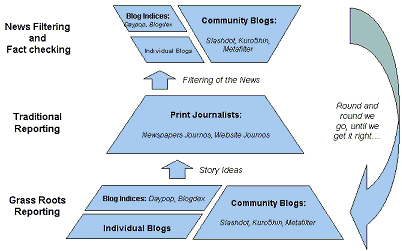
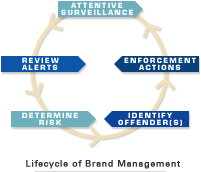
Following on from my blog on Tuesday - In blogs we trust - an article in The Guardian reports on the increasing threat of blogs to businesses and their carefully crafted brand imagery. See Firms in the dark over blog threat by Dominic Timms. One of the main conclusions from the study conducted by The Angel Blog is that 60 per cent of PR executives interviewed believed that web blogs by unhappy employees or exasperated customers can damage corporate reputations, but 58% said businesses were insufficiently aware of the threat. Alternatively, see businesses must 'wake up to blog threat' by Holden Frith of The Times.

Some quite important work-related news emerged over the last few days. First of all, it has been suggested by the Confederation of British Industry that many firms have lost faith in the employment tribunal system following regulation changes and too many now settle cases they could have won - Firms 'avoiding work tribunals' (BBC News) . Secondly, new sexual harassment legislation, aimed at tackling discrimination in the workplace, has come into force. In brief, the European Equal Treatment Directive has extended the definition of sex discrimination to cover any act that leads to intimidation or degradation (BBC News).

Two new work-related blogs to add: the tales of a New York escort - A New York Escorts Confessions; and, an aircraft controller at Wheelie's.

The daily life of migrant labour

Read about a week in the life a Chinese builder beginning to work in the UK- Diary of a migrant worker (The Guardian). A shame that it hasn't been turned into a blog.

Those on national minimum wage will be pleased to know that it is increasing to £5.05 ($8.94) from today (BBC News). The 18 to 21 year old rate also goes up to £4.25 ($7.52). Provisional recommendations by the Low Pay Commission suggests rates are to increase to £5.35 ($9.47) and £4.45 one year ($7.88) from now, respectively.

Confused by IT terminology such as javascript and jpeg? Well, you're not the only one and the bulk of office staff are 'baffled by IT jargon' (The Scotsman).

If your current job hasn't turned out as you planned, or you are in a job that is not fulfilling as it once was, then Andrew Taylor of The Times considers alternative strategies to just finding another job - try and alter the job.